An interview with the Co-Founder of Himba Raya Indonesia. Article by Dian Dewi.
Himba Raya Indonesia is a non-profit organization that aims to raise awareness about environmental degradation, and the need for solutions that support local communities In Central Kalimantan, Indonesia.

There are moments during interviews where a single sentence quietly reframes the entire conversation.
In this case, it was simple.
“Planting trees is like raising children.”
I was speaking with one of the co-founders of Himba Raya Foundation, often known as Hirai, a young environmental foundation based in Central Kalimantan. What began as a conversation about reforestation gradually widened into something else. Indigenous knowledge systems. Ecological collapse. Youth activism. Peatland fires. Palm oil. Education. Responsibility.
And beneath all of it, relationship to land.
Hirai officially began on 21 February 2021, founded by three young co-founders from Central Kalimantan. The organisation focuses on environmental restoration, education, and community-based ecological work.
At the time, the founders themselves were still very young. “We saw that young people in Central Kalimantan were not really being heard,” she explains. “There is a stigma that because we are young, our voices are not important.” The issue was not lack of concern, but lack of space. Particularly in environmental discussions that directly affect younger generations inheriting the long-term consequences.
“Kalimantan is often called the lungs of the world,” she says. “But we see that Kalimantan is sick.”
The realities she refers to are well documented. Deforestation, peatland degradation, recurring haze disasters, and large-scale ecological disruption linked to fire cycles that intensify during El Niño periods.
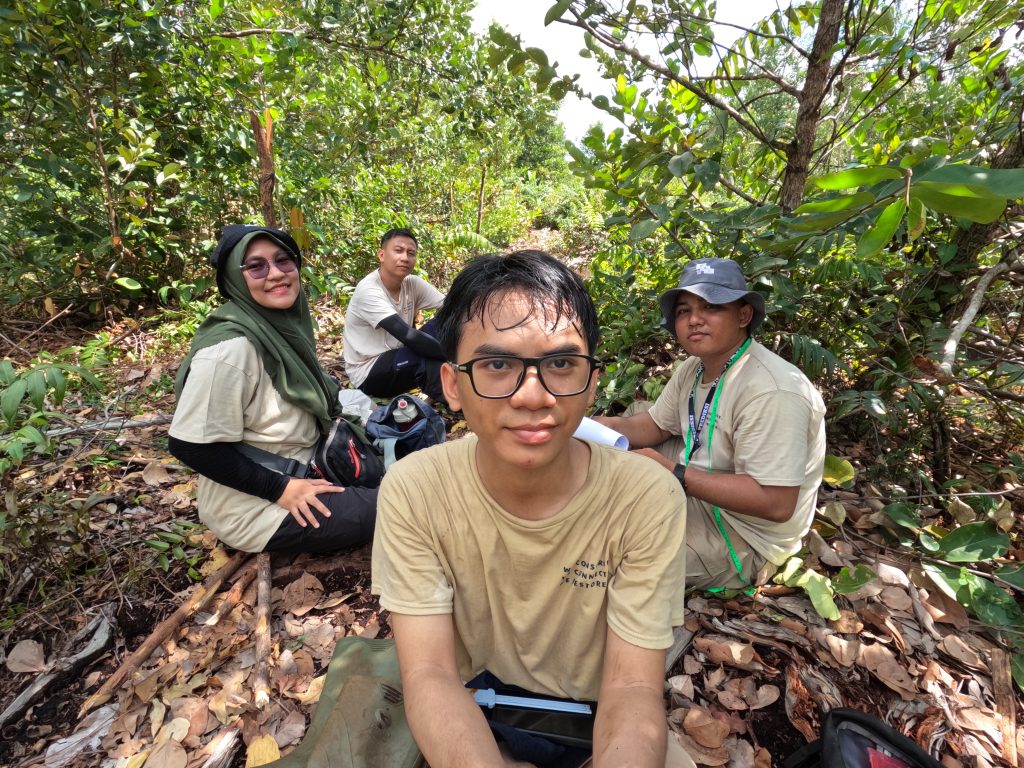
Like many grassroots environmental organisations, Hirai began with tree planting initiatives. But very quickly, the work revealed itself to be far more complex than symbolic environmental campaigns.
“Planting a tree is not easy,” she says. “It is like raising a child.” The comparison is practical rather than sentimental. “You have to visit them. Monitor their growth. Give them nutrition.”
The foundation formally began restoration projects in 2022 after securing foundation status and early funding support. Initial funding was modest, around USD 5,000, but enough to begin rehabilitation work in degraded peatland areas.
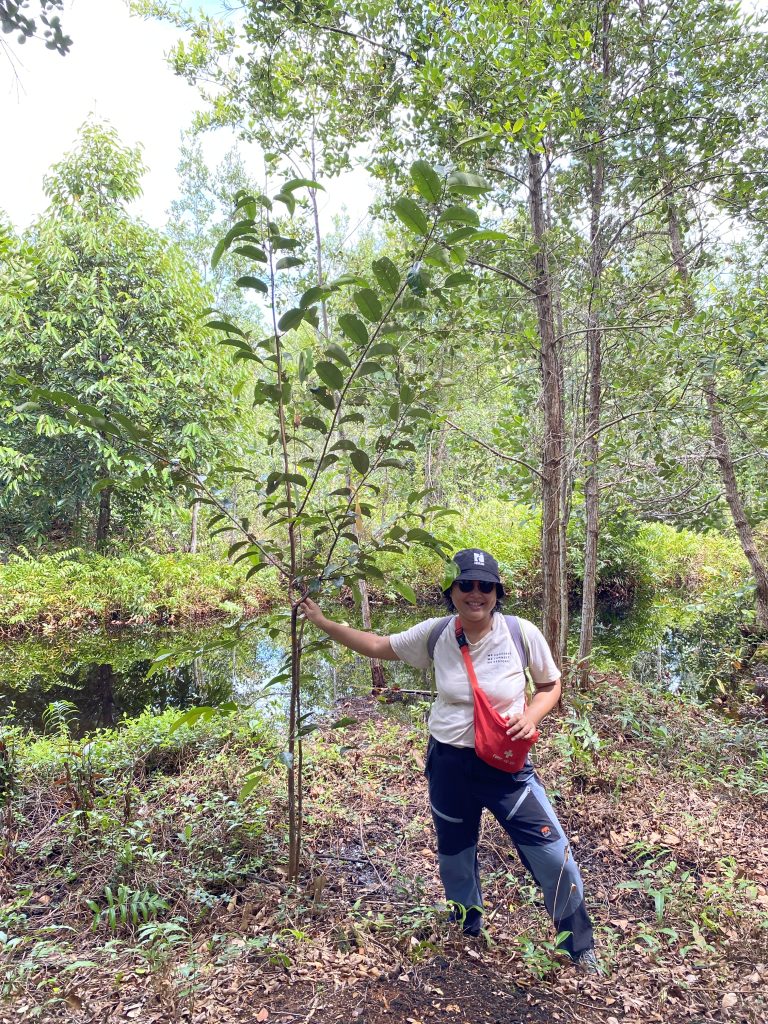
Several years later, many of those trees now stand four to five metres high. “My children,” she says, laughing softly. There is affection in the way she speaks about them, but also accountability. Restoration here is not treated as short-term visibility work. It is measured through survival.
Throughout the interview, the conversation repeatedly returns to indigenous Dayak philosophy.
One of the central concepts she refers to is Batang Garing, often understood as the Tree of Life within Dayak cosmology.
The tree symbolises interconnectedness between spirit, humanity, nature, and the wider universe.
“For Dayak people, forest is life,” she explains. “Our ancestors survived through the forest.”
Historically, communities lived directly through ecological knowledge systems. Forest plants provided medicine, water, food, materials, and shelter. Knowledge passed through generations was practical, not abstract.
She describes how water stored inside large jungle roots could be harvested and drunk directly in the forest. “The tree gives the water of life,” she says. The philosophy also extended into social structures.
Traditional rumah betang, or longhouse systems, reflected principles of collective living, coexistence, and relative gender equality. “We did not have patriarchy in the way people often assume,” she explains. “Women’s voices were heard.”
At the same time, she acknowledges that social structures continue to evolve as outside influences and modern economic systems increasingly shape village life.
One of Hirai’s stated goals is to act as a bridge between traditional ecological knowledge and modern environmental systems. “Hirai is here because we want to bring back local wisdom,” she says. “But we also cannot leave technology behind.”
The organisation uses environmental monitoring systems and field data to track restoration outcomes. Approximately 9,000 planted trees have survived across rehabilitation zones so far. At the same time, she stresses that modern environmental work often overlooks local practical knowledge already embedded within communities.
For example, local farmers traditionally avoid planting during peak daytime heat in peatland areas because humidity and exposure can quickly damage young trees.
“Morning and late afternoon are best,” she explains. “That is local knowledge.”
Much of Hirai’s work focuses on peatland ecosystems, or gambut, which play a major role in carbon storage and ecological regulation. Peatland systems are highly sensitive. Once burned, they release extremely large amounts of stored carbon and become vulnerable to recurring fire cycles.
“If peatland burns during El Niño, even a small fire can spread very quickly,” she explains.
This year, Indonesian scientists have already warned about the potential impacts of a severe El Niño cycle across parts of Indonesia, including Central Kalimantan. Hirai currently works alongside community fire patrol groups and local volunteers to monitor vulnerable forest areas.
One of the organisation’s key restoration sites is Tumbang Nusa, an area repeatedly affected by major fires over recent decades.
I asked whether these fires were historically part of Borneo’s ecological pattern. Her answer was immediate. “No. Not naturally.” She points instead to large-scale land conversion projects that dramatically altered the ecosystem.
During previous eras, there were attempts to convert vast peat forest regions into agricultural rice fields across Central Kalimantan. The project ultimately failed due to unsuitable acidic peat soil conditions, but large-scale deforestation and drainage had already taken place.
Palm oil expansion followed soon after. “That was when the balance changed,” she says. Subsequent large-scale food estate projects repeated similar patterns of clearing and ecological disruption. The consequences continue to affect local communities and ecosystems decades later.
One of the more striking parts of the conversation centres around environmental education itself. In some communities, younger generations increasingly understand industrial palm oil plantations as equivalent to “planting trees.” “The messaging is very strong,” she says carefully.
Economic realities also shape these perceptions. In many regions, communities face limited alternatives for employment and financial stability. Rather than blaming local communities directly, Hirai focuses strongly on education and social outreach programs with schools and universities.
“I don’t say local people have low capacity,” she explains. “They often just do not have equal access.” Access to environmental education, broader opportunity. and to different ways of imagining the future.
Throughout the interview, what became increasingly clear is that Hirai’s work is not only about planting trees. It is also about restoring continuity. Between younger generations and ancestral knowledge, environmental science and lived local experience. Between modern systems and older relationships with land.
The sentence about raising children returns quietly at the end of the conversation. Not emotionally overstated. Just matter of fact. Real restoration requires long-term care. Monitoring. Patience. Protection. Attention over time.
Much like raising anything intended to survive into the future.
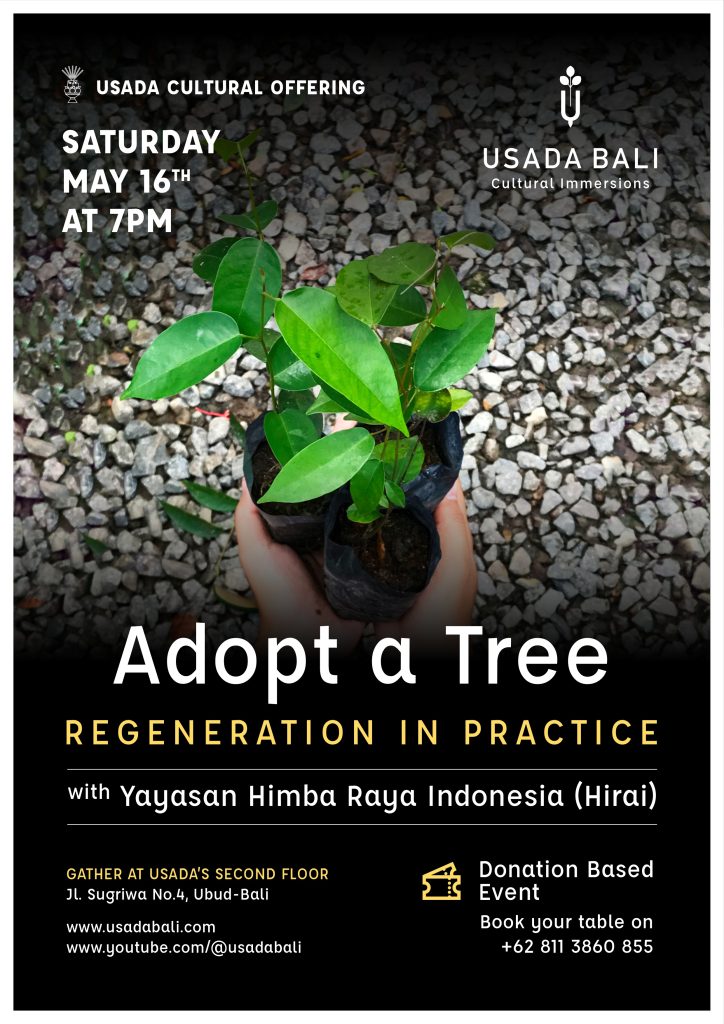
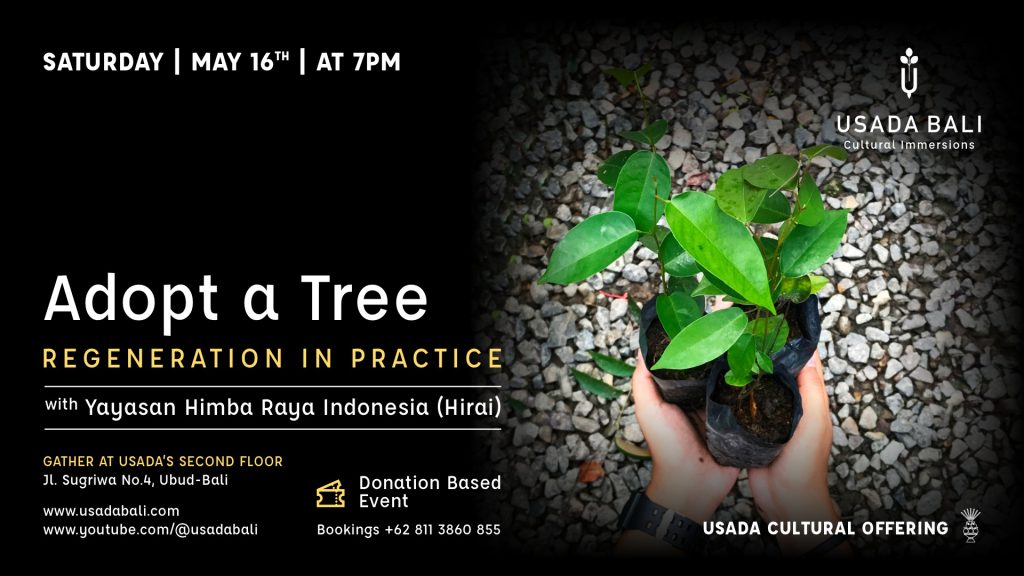
Join Yun Pratiwi at Usada Saturday May 16th for an evening of knowledge sharing and supportive community input for our environment.