Joo Peter is a German documentary filmmaker, writer, photographer and artist whose work explores culture, community and the relationship between people and nature. Since 2014, he has travelled extensively through Asia, with a particular connection to Indonesia and Bali, documenting traditional cultures and contemporary life through film, photography and writing.
For Joo Peter, some of the most intriguing artworks at a Balinese ngaben are also among the easiest to miss.
He began noticing them after attending many cremation ceremonies in Bali from around 2005 onwards. In the early years, it was the ritual itself that held his attention: the preparations, the procession, the offerings and the many layers of meaning within the ceremony. But after returning again and again, his eye began to settle on something else: the paintings that line the walls around the cremation ground. Joo calls them FireWall paintings.
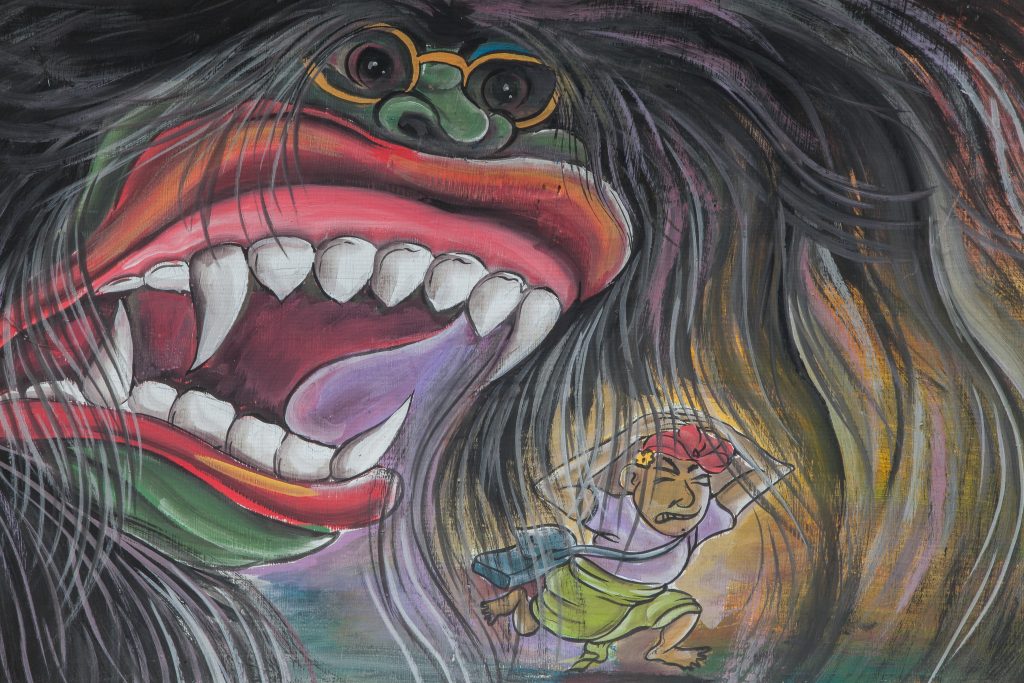
They are temporary, often made on thin fabric or paper, and placed around the area where the body will be cremated. They can depict traditional stories of the unseen world, the passage after death and the journey towards liberation. But they can also be surprisingly free. For Joo, that freedom is what makes them so interesting.
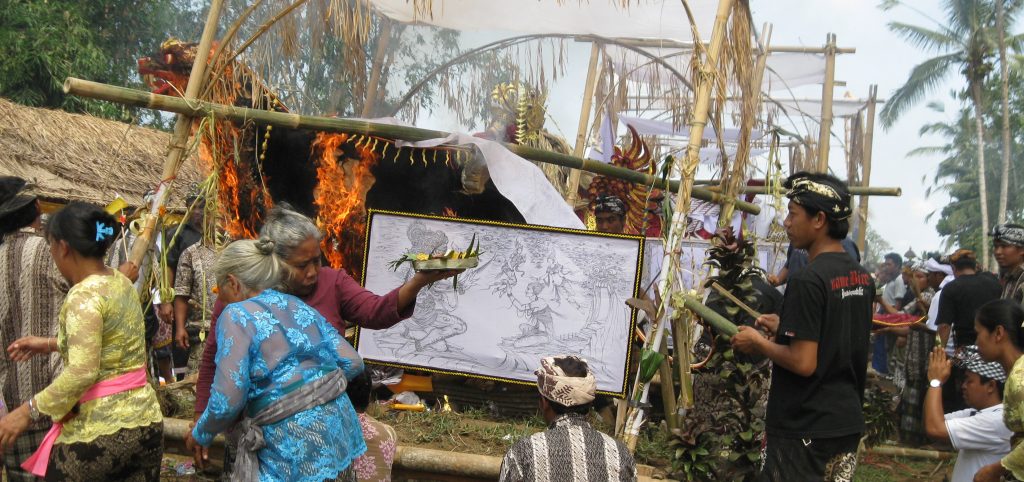
A family and its chosen artist might follow familiar mythological imagery, or they might create something much more personal. A painting can approach death with seriousness, spirituality or humour. It can even become satirical. “There is a wide range of storytelling,” Joo says.
Walking through a large ngaben, these different approaches can exist alongside one another. The paintings become part of the temporary landscape of the ceremony, alongside the wadah, offerings, ritual objects and crowds of people moving towards the cremation.
For Joo, this creates an unusual kind of visual conversation. “How do we deal with death? How do we process it?” There is no single answer. Perhaps that is why the paintings can move so easily between the sacred and the comic.
The FireWall has a practical function. It helps contain the fire around the place where the body is burned.
But the material itself gives the painting another significance. Made on a thin layer of fabric or paper, it becomes almost like a curtain. On one side is the world of the living. On the other is the fire and the transformation taking place within it.
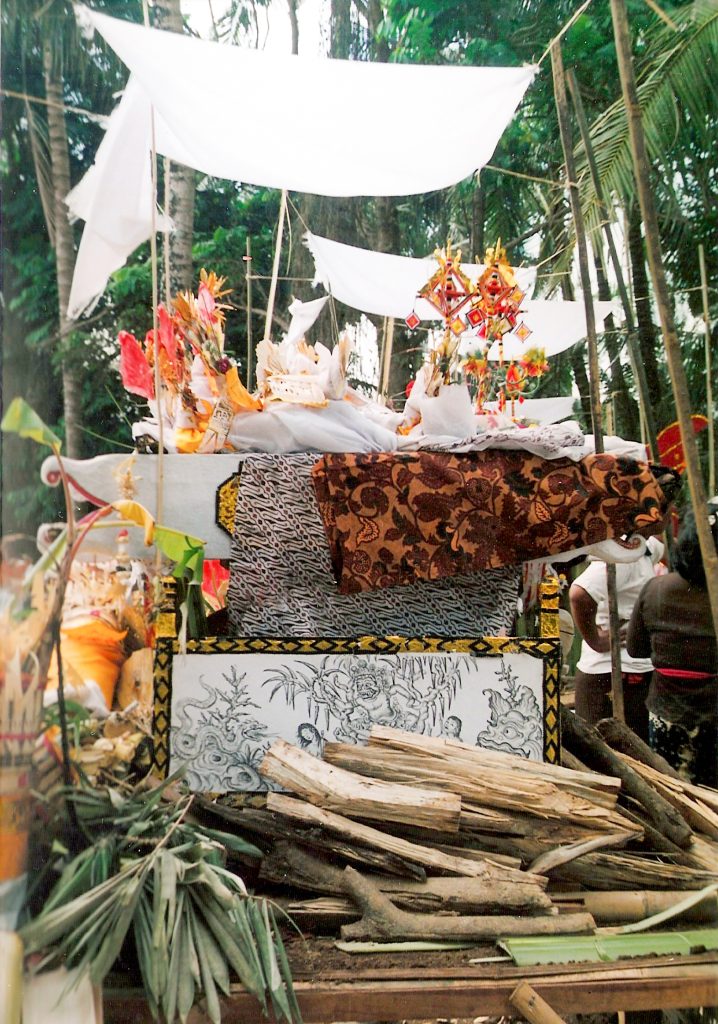
Then the curtain itself burns. For Joo, this makes the painting more than an image representing death. The artwork becomes part of the ritual it is depicting. It is created for a particular moment and then disappears in that moment. There is something powerful in that.
One of Joo’s strongest observations is also one of the simplest: people often don’t notice the paintings. The major elements of a ngaben naturally draw the eye. The towering wadah, the procession, the bull, the offerings and finally the fire all command attention. The FireWall paintings sit much closer to the ground.
Yet when you stop to look, they can reveal an extraordinary amount about the people who made them.
Joo remembers seeing contributions from people of very different ages and backgrounds. A teenager might take part. A child might add something. An artist trained in traditional imagery might work alongside someone whose visual language comes from cartoons, tattooing or contemporary art. The result can carry something of the family itself. “There is a family spirit in the FireWall paintings,” he says.
Joo is also interested in what these images might tell us about the deeper layers of Balinese culture. In conversations with Balinese artist I Ketut Budiana, he has explored the relationship between contemporary Balinese Hinduism and older animistic and ancestral traditions. Budiana’s own work is deeply connected to traditional Balinese culture and its spiritual dimensions.
The FireWall paintings open another way of looking at those layers.
Images of the underworld and the passage after death are not unique to Bali. Joo sees echoes of them across many ancient cultures. The details may differ, but the human questions are familiar: what happens after death, where do we go, and what does transformation mean? This is where the paintings become both distinctly Balinese and strangely universal.
Joo Peter is particularly drawn to the contrast between the spiritual and the physical in these images. Ideas of paradise can suggest a return to an original state, while the journey through death brings the body back to nature. At the same time, depictions of hell can be intensely physical, sometimes grotesque, sexual or humorous.
The contrast is striking. The spiritual and the earthly are not necessarily separate and occupy the same image, just as they occupy the same ceremony.
Perhaps the most interesting thing about the FireWall paintings is that they ask us to look at something that is already there. They are not separate from the ngaben. They are part of it. They sit along the path, close to the ground, telling stories about death, transformation, memory and the unseen world. Some follow established imagery, while others reveal the personality and imagination of the people who made them.
And for a short time, they hold the space between life and death. Then the fire takes them.
For Joo, that is part of their beauty. The paintings do not simply depict transformation. They undergo it themselves.
FireWall Paintings is an ongoing area of research and observation for Joo Peter, whose work in Bali brings together documentary film, photography, art and cultural exploration. For more on his work and writings visit www.sawidjiarchives.com
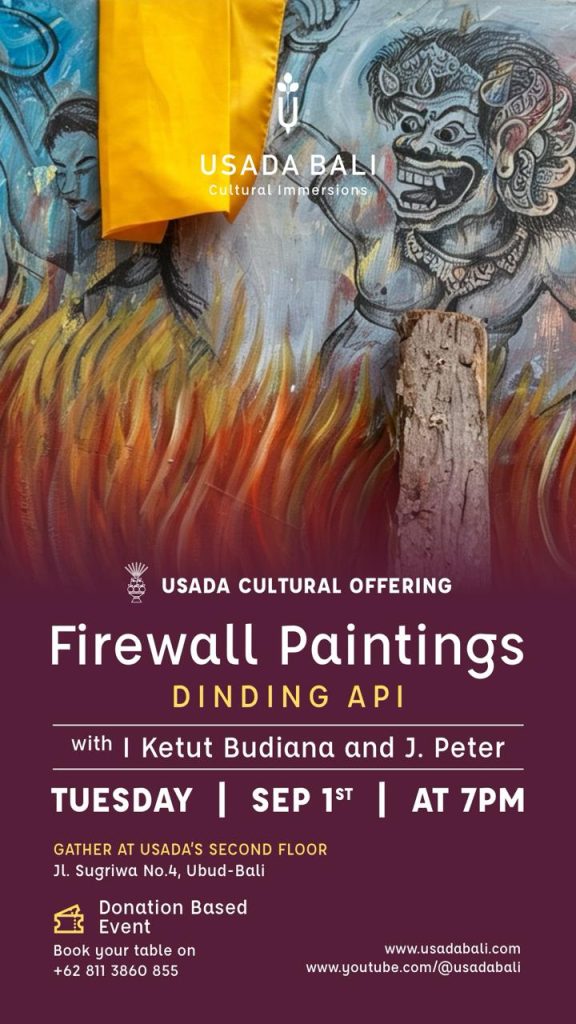
Ketut Budiana with Joo Peter at Usada Bali this September