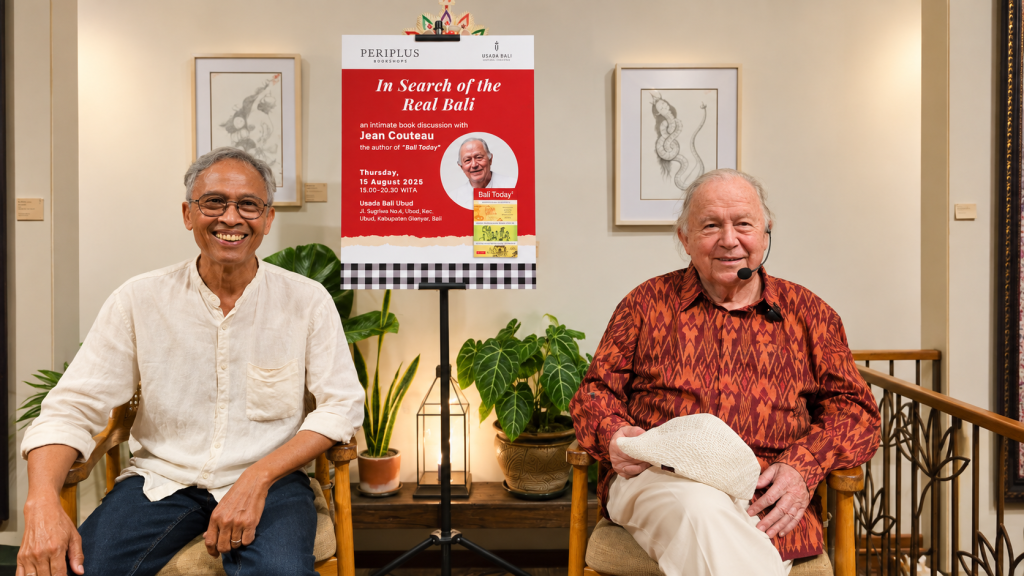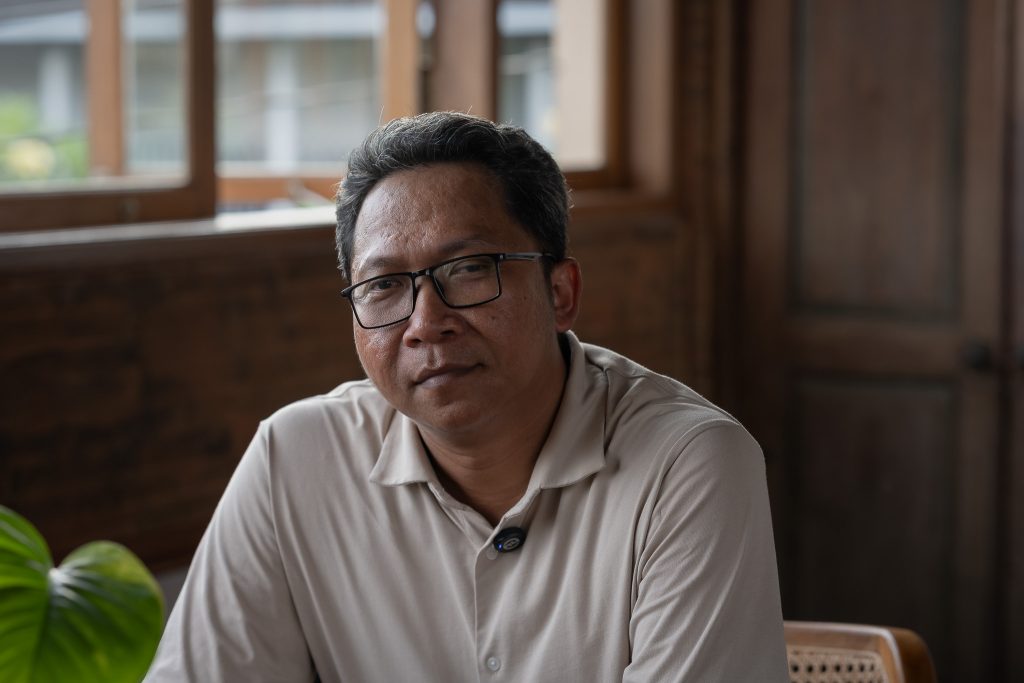
This article documents Dr. Krisnawan presentation, Beyond Coping: Building the Capacity to Thrive, delivered at Usada Bali. It is an editorial interpretation of the presentation and is intended to share its key themes and insights with readers who were unable to attend.
Dr. Krisnawan. Co-Founder of UbudCare Wellness, General Practitioner and Pranic Healing Practitioner and Instructor. Dr.Krisna shares his knowledge and experience through talks and workshops at Usada, Bali.
Building Resilience as a Daily Practice. This article is written as a documentation of Dr. Krisnawan, MD’s presentation, Beyond Coping: How to Build Resilience to Thrive Despite Life’s Challenges, delivered at Usada Bali. It is an editorial interpretation of the presentation and is intended to share its key themes and practical insights with readers who were unable to attend. Read first: Beyond Coping: Building the Capacity to Thrive
If resilience is something we build rather than something we are born with, then the obvious question becomes, how?
Following his exploration of stress and resilience, Dr. Krisna turned the discussion towards the everyday practices that slowly expand our capacity to meet life’s challenges. There was no promise of a quick fix or a single technique capable of removing suffering. Instead, what emerged was a picture of resilience as something cultivated through consistency, often in surprisingly simple ways.
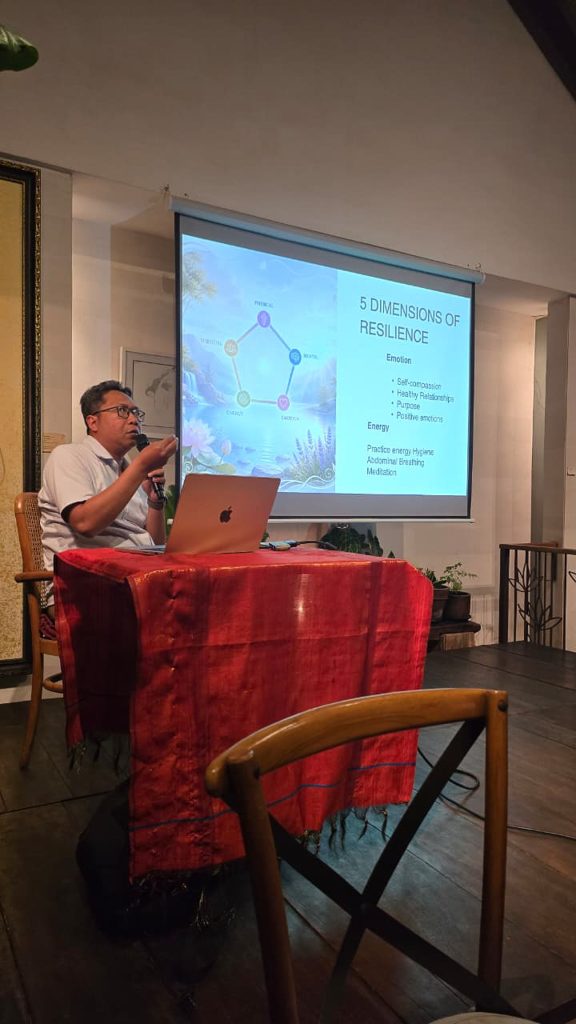
One of the strongest impressions left by the evening was that resilience cannot be reduced to mental strength alone. When we experience prolonged stress, it is rarely confined to one part of ourselves. The body grows tired, sleep becomes disrupted, emotions become more reactive and the mind begins circling the same thoughts. Dr. Krisna suggested that if stress affects us as a whole person, then resilience must also be built as a whole person.
This holistic view underpins both his medical practice and his work with Pranic Healing. Physical health, emotional wellbeing, mental clarity, our energetic state and our spiritual outlook are not isolated systems but continually influence one another. Looking after one naturally supports the others.
It is easy to assume that resilience is something developed through willpower. Dr. Krisna gently challenged that assumption. A body deprived of sleep, movement or proper nourishment has fewer resources available when life becomes difficult. Looking after our physical health is not merely preventative medicine; it is one of the foundations upon which emotional and mental resilience depend.
Simple movement was one of the most practical recommendations offered during the evening. Walking, dancing, stretching or exercising does more than strengthen muscles. It interrupts the cycle of repetitive thinking that often accompanies chronic stress, returning our attention to the present moment through the body itself.
Sometimes the most effective way to quiet the mind is not to argue with it, but simply to move.
One of the more distinctive aspects of the presentation was Dr. Krisna’s invitation to consider energy as another dimension of health. Just as we wash the physical body every day, he suggested that our energetic body also benefits from regular care. Throughout the course of a day we accumulate emotional interactions, mental activity and environmental influences that can leave us feeling depleted or unsettled.
Rather than viewing energy as something abstract, he described practical ways of maintaining energetic wellbeing through conscious breathing, spending time in healthy environments and developing positive emotional habits.
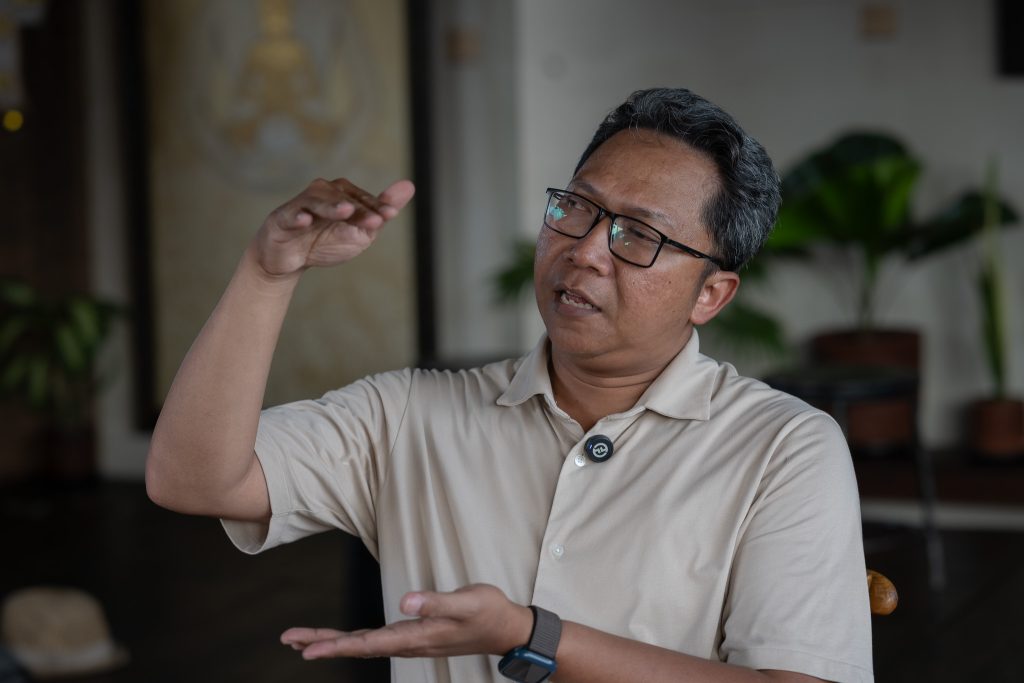
He also spoke about the importance of the chakras and energy channels recognised within Pranic Healing. While these concepts may be unfamiliar to some, the underlying principle is simple: caring for our inner environment is every bit as important as caring for our outer one.
Perhaps the simplest practice shared during the evening was also one of the most accessible. Many of us breathe high into the chest, particularly when we are anxious or under pressure. Without realising it, this shallow pattern reinforces the body’s stress response.
Abdominal breathing gently reverses that process. By allowing the diaphragm to expand with each inhalation and soften with each exhalation, the nervous system begins receiving signals of safety rather than danger. From the perspective of Pranic Healing, this deeper breathing also supports the flow of prana, or life energy, throughout the body while easing tension held around the solar plexus.

It is a reminder that something as ordinary as breathing can become a daily practice in resilience.
Throughout the evening, Dr. Krisna returned repeatedly to the idea that resilience is strengthened through ordinary habits rather than extraordinary moments. Gratitude was one such practice.
Not because it erases difficulty, but because it changes where our attention rests. When gratitude becomes a habit, the mind gradually spends less time reinforcing fear and more time recognising what continues to support us.
Journalling offers something similar. Putting thoughts onto paper prevents them from endlessly circulating in the mind. Dr. Krisna even suggested keeping two journals, one to release difficult emotions that no longer need to be carried, and another to record moments of kindness, encouragement and joy. One is eventually let go of. The other becomes something worth returning to.
He also introduced a simple technique of recalling a deeply positive memory, allowing the emotions connected with it to arise again before anchoring the experience with a smile. Practised repeatedly, this memory becomes easier to access during periods of stress, offering a healthier emotional reference point when life feels overwhelming.
None of these practices remove life’s challenges. They simply help us meet them from a steadier place.
Compassion is often spoken about as something we offer to others. Dr. Krisna suggested that resilience begins by directing some of that kindness towards ourselves. Forgiving ourselves for our mistakes and forgiving ourselves for neglecting our own wellbeing.
Remembering that we are not defined by every passing emotion or every difficult thought. One of the more thoughtful reflections of the evening was the invitation to notice the language we use. “I have a headache” is different from “I am in pain.” “I feel sadness” is different from “I am sadness.”
The distinction may appear small, yet it creates space between our experience and our identity. We begin recognising that thoughts, emotions and physical sensations move through us. They are part of our experience, but they are not the whole of who we are.
As the evening drew to a close, the conversation returned once again to resilience. Not as an achievement or as a permanent state of happiness but as a way of meeting life.
There will always be uncertainty. Health changes. Relationships and circumstances change. Nothing remains fixed for very long. Perhaps resilience is not about preventing change at all but about developing the capacity to move with it.
That capacity is built quietly through the choices we make each day. Caring for the body. Calming the mind. Looking after our energy. Nurturing relationships. Finding moments of gratitude and returning to the breath.
None of these practices are dramatic in themselves. Together, however, they become the foundations of a life that is not merely surviving adversity, but continually growing through it.
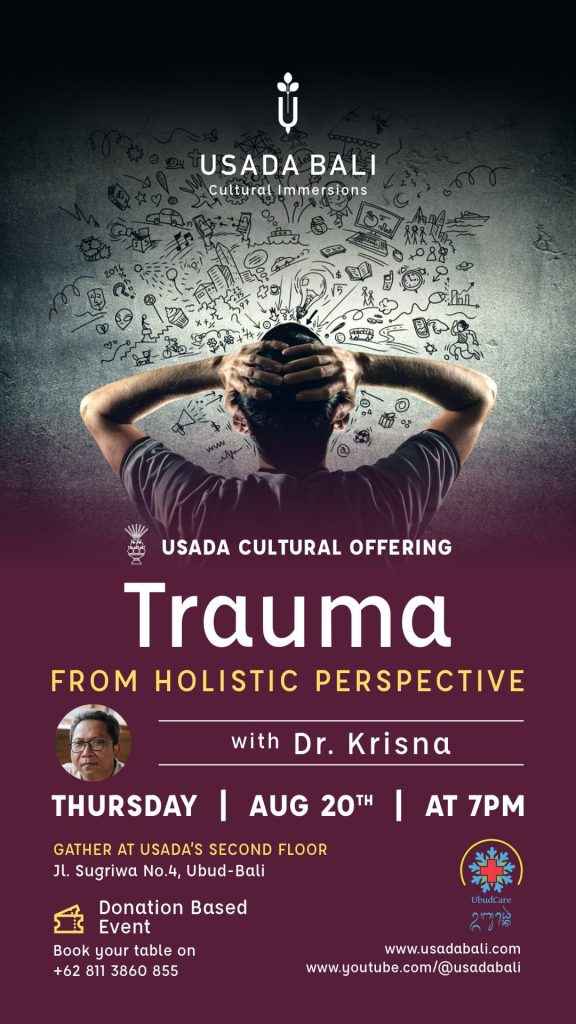
Trauma from a Holistic Perspective: Exploring the Physical, Emotional, Mental & Energetic Dimensions
Trauma is more than a memory. It can shape the way we think, feel, relate, and experience the world, often leaving imprints on the body, mind, emotions, and energy long after an event has passed.
Join us for an insightful discussion exploring trauma through a holistic lens. Discover how different dimensions of our being are interconnected, and learn practical perspectives on healing that go beyond symptom management. An invitation to deepen your understanding of yourself and the path toward greater resilience, balance, and wholeness.