Reflections on Balinese ancestral traditions from a talk by Jean Couteau at Usada
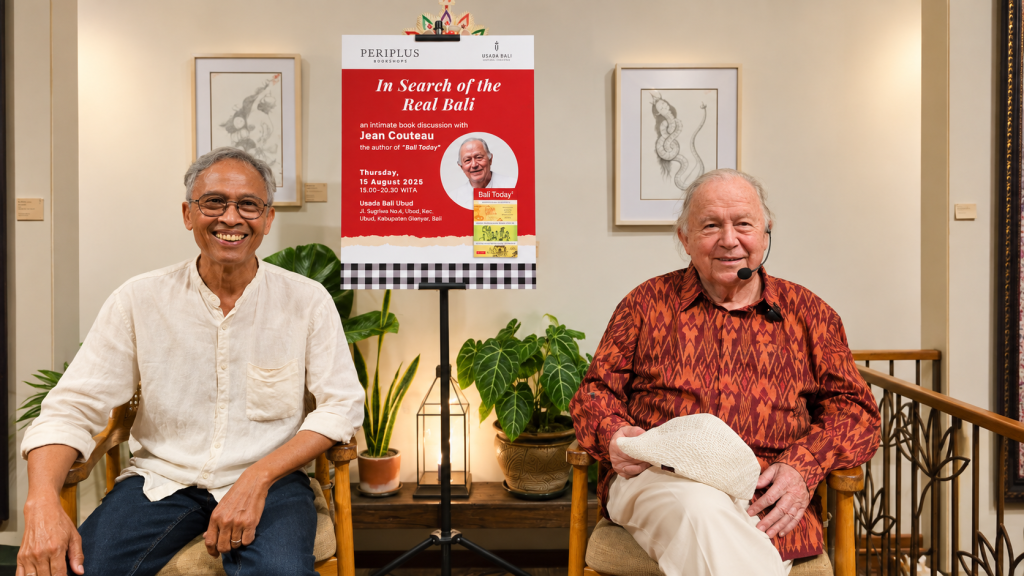
Editor’s Note The following article is based on a talk by Jean Couteau presented at Usada, exploring the cultural and spiritual dimensions of Galungan and Kuningan in Bali.
Couteau’s reflections draw attention to the importance of ancestral relationships, ritual cycles. As well as the ways Balinese communities understand connections between humans, nature, the divine and the unseen world.
The interpretation presented here reflects one perspective within the wider and diverse landscape of Balinese religious and cultural traditions. Balinese Hindu practice has developed through many layers of history, including indigenous traditions, local village customs, and influences from Indian religious and philosophical traditions.
Rather than offering a single definition of Balinese belief, this article invites reflection on the meanings carried through ceremony, family lineage and the continuing relationship between generations. For many visitors, Galungan is often described simply as the Balinese celebration of the victory of dharma over adharma. Good over negative forces. While this explanation is familiar, the deeper layers of Galungan reveal a much more intimate relationship. The relationship between the living, the ancestors, and the unseen forces that maintain balance in the world.
According to Jean Couteau, much of Balinese ritual life is centred not only on formal religious concepts, but on inherited practices, obligations, and relationships passed through generations. Balinese traditions have developed through a meeting of influences: ancient local traditions connected to mountains, water, ancestors and the landscape, together with layers of Indian influence expressed through literature, epics and cosmology.
From this perspective, ancestor veneration remains one of the most important foundations of Balinese ceremonial life. The Balinese religious world is not experienced only as a system of belief or doctrine. It is lived through daily actions. Offerings, ceremonies, temple obligations, and maintaining harmony between humans, gods, ancestors and the forces of nature.
The rhythm of Balinese life is governed by the Pawukon calendar, a cycle of 210 days. Unlike a simple solar calendar, this system consists of multiple overlapping cycles of weeks. Each carrying its own qualities and significance.
This calendar traditionally guides important moments of life: birth ceremonies, marriages, cremations, temple festivals and other rituals. The question is not only what happens, but when it should happen. Finding the right moment when the cosmic balance is supportive. Within this cycle, Galungan appears as a central point: a time when ancestral and divine forces are believed to return and visit the world of their descendants.
In a traditional Balinese family compound, the merajan or sanggah (family temple) contains sacred shrines where ancestors are honoured. One of the most important is the Rong Telu, the three-part shrine associated with ancestral presence. During Galungan, ancestors are welcomed back.
The relationship is not distant or abstract. They are not simply remembered, they are invited to return, to dwell among their descendants, and to share in the offerings prepared for them. Through ritual, sacred objects and ancestral symbols become a place of presence. Food is prepared, prayers are offered, and family members communicate with the ancestors as they would communicate with respected members of the family.
The ceremony reflects a deeply relational understanding of existence: the dead are not separated completely from the living. They remain part of the family lineage.
In this worldview, the wellbeing of the family is connected to maintaining these relationships. Problems that occur in life — illness, misfortune, difficulties, may be understood as signs that balance needs to be restored, including through attention to ancestral obligations.
The Balian (traditional healer or spiritual practitioner) often plays a role in helping families understand these disturbances and restore harmony. While Brahmin priests perform important temple rituals and provide sacred water (tirta), the daily relationship between individuals, families and unseen forces is often maintained through local practices and community knowledge.
The days leading toward Galungan involve preparation and purification. Offerings are made, ceremonies are performed, and households prepare to welcome the returning ancestors. The famous penjor, the decorated bamboo pole placed outside homes, is not merely decoration. It represents gratitude, abundance and the relationship between humans, nature and the divine.
Galungan therefore becomes more than a festival. It is a renewal of connection: between past and present, ancestors and descendants, the visible world and the unseen. It reminds the Balinese community that life exists within a continuous cycle, one where generations are not separate, but connected through memory, duty and devotion.
You may also want to read https://usadabali.com/nyepi-stillness-and-the-renewal-of-balance/